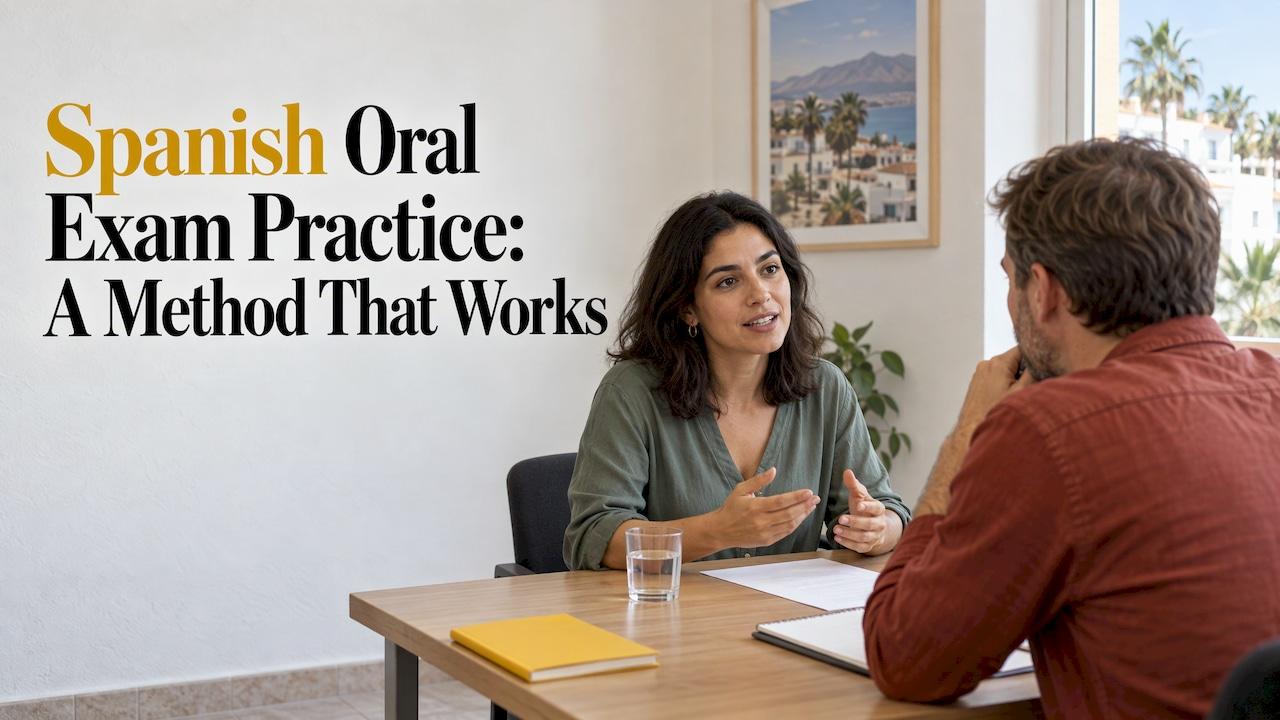
The best way to practise for a Spanish oral exam is to rehearse the exam itself: the same tasks, the same timings, speaking aloud to a real person who reacts and gives you feedback. Memorised paragraphs and silent revision do not prepare you for that. Below you will find what the main orals involve, a routine you can start this week, the phrases that rescue you when you freeze, and how a live teacher shortens the process.
This guide is written for adult learners: people sitting DELE or SIELE, A-level or IGCSE candidates, and professionals or expats who need to speak under pressure. If you want a teacher to run mock orals with you, our DELE preparation is taught live by native Spanish teachers on Microsoft Teams.
TL;DR
-
Find out exactly what your exam asks you to do (tasks, timings, preparation time) and practise those tasks, not general conversation.
-
Learn structures, not scripts: an opening, two or three ideas with reasons, a close. Examiners reward communication, and rehearsed speeches are penalised.
-
Record yourself, listen back twice (content, then language), and use a stopwatch from the first week.
-
Learn a handful of repair phrases so a misheard question never ends your answer.
-
Do at least some of your practice with a real person who interrupts, questions and corrects you.
Table of Contents
What a Spanish oral exam actually asks of you
Spanish orals differ more than most learners expect, so the first job is to read your exam’s format. Three families cover most adult candidates.
DELE (Diplomas de Español como Lengua Extranjera, the official Spanish diplomas awarded by the Instituto Cervantes) tests speaking face to face. The B1 oral expression and interaction test lasts 15 minutes plus 15 minutes of preparation, with four parts: a talk on a topic of two to three minutes, a dialogue of three to four minutes, a photo description with questions from the examiner, and a short role-play. Madrid’s regional education service describes the same pattern across levels: a short personal presentation, a topic exposition and a conversation at one level, and a monologue, photo description and imaginary-situation dialogue at another.
IGCSE and A-level orals are teacher-run and structured around set topics. Cambridge’s IGCSE Spanish speaking test lasts about 10 minutes plus 10 minutes of preparation and carries 40 marks: a short unassessed warm-up, a two-minute role-play with five transactional questions, and two four-minute topic conversations. You may not make notes during the preparation time. At AS level, Cambridge’s specimen tests show a presentation with follow-up discussion and a conversation task card with five minutes to read and prepare.

SIELE speaking is a different animal from DELE, and it rewards a different kind of rehearsal, so check the current format on the official SIELE site before you plan your practice.
Whichever exam you sit, the questions to answer before you practise a single sentence are:
-
How long is the preparation time, and are notes allowed?
-
Which tasks are monologue and which are interaction?
-
Who is listening: an examiner who interacts, or a recording?
-
What is assessed: content, fluency, accuracy, range, pronunciation?
What examiners are really marking
Most learners over-invest in grammar tables and under-invest in sounding like someone communicating. Examiner guidance across boards points the same way.
Pearson’s guidance for its modern-language orals tells examiners to ask open questions that push candidates to the limit of their language, stay friendly, and interrupt pre-rehearsed sections. In other words, a memorised speech does not survive contact with a good examiner. Cambridge’s moderator comments on a sample AS candidate say the same: avoid reading or mentally reciting prepared responses and note key ideas instead.
On pronunciation, Pearson’s GCSE speaking guide is reassuring. In the read-aloud task, pronunciation is judged on clarity and comprehensibility, not accent, and an anglicised accent does not hurt you if the sounds are clear and match the spelling. So do not spend weeks chasing a perfect accent. Spend them on clear vowels, stressed syllables in the right place and finishing your words.
A weekly routine for Spanish oral exam practice
The routine below suits eight to twelve weeks of preparation. Adjust the minutes to your schedule, but keep the order.
Step 1: Map the exam to your level
The Instituto Cervantes publishes DELE model exams from previous sittings with answer keys and an oral preparation guide. Use them in week one to see the real tasks and to judge your level honestly. If you sit a school or university oral, ask for the board’s specimen tasks and mark schemes. Cambridge, for instance, provides example candidate responses with examiner comments, a step-by-step speaking test video and specimen tests.
Where it goes wrong: learners practise “general chat” and are surprised by a photo description or a role-play with a stranger’s demands. In a lesson with us, the first task is to match your goals and level to the exam tasks, so your practice time goes on what is actually marked.
Step 2: Build structures, not scripts
For every monologue task, learn a skeleton you can fill with any topic:
-
Opening: one sentence that says what you will talk about (“Voy a hablar de…”).
-
Two or three ideas: each with a reason or an example (“Primero…, además…, por eso…”).
-
Close: a sentence that returns to your opening idea (“En resumen…”, “Al final…”).
Practise the skeleton on varied topics: work, technology, the environment, leisure, travel, health, family. The same connectors (primero, además, sin embargo, por eso, en conclusión) carry you through all of them, and they also make you sound organised under pressure.
If the exam gives you preparation time, use it for keywords, not sentences. Writing a full text invites you to read it out, which is exactly what examiners are trained to spot.
Step 3: Record, then listen twice
Take a prompt from a past paper, set a stopwatch to the real task length and answer aloud into your phone. Then listen back twice: once for content (did I answer the question, was it organised, did I recover from slips?), and once for language (filler words, long silences, swallowed word endings, tenses). Run a few full mock orals without stopping, because the stopwatch is the part you cannot fake on the day.

Keep a one-page log: the date, the task, the time you ran to, and the three things to fix next time. After four weeks the log shows you your real patterns, which are usually fewer than you feared. Typical examples are drifting into the present tense for everything, dropping the reflexive pronoun, or running out of ideas at 90 seconds.
Step 4: Practise with a person
Speaking alone in front of a mirror trains fluency. It does not train interaction, which is where most oral marks are decided: understanding a question you did not expect, reacting to what is said, and keeping your answer going. You need someone who interrupts, asks “¿por qué?”, changes topic and pushes you past the sentence you prepared.
A native teacher does this on demand and then tells you precisely what cost you marks. Our one-to-one lessons are €25 per lesson, and semi-private lessons are €13 to €20 per person per lesson, so you can pair up with another candidate and split the cost. Both run live on Microsoft Teams with native Spanish teachers, which suits learners in Spain and abroad.
Step 5: Run full mocks and review them
In the last three or four weeks, replace most topic work with complete mock orals under exam conditions: the same preparation time, the same task order, no notes beyond what the exam allows. Review each one against the marking criteria, not against your feelings. Cambridge’s specimen speaking tests come with moderator comments on where candidates gained marks and where they could improve, which is a useful model for how to mark your own recordings.
Phrases that keep you talking when it goes wrong
Every candidate misses a question or blanks on a word. The difference between a good and a poor mark is often the recovery. Learn these until they are automatic:
| Situation | What to say | Why it helps |
|---|---|---|
| You did not hear or understand | ¿Puede repetir, por favor? / ¿Cómo? | A natural request, not a failure |
| You need a moment | Bueno… / Pues… / A ver… | Buys two seconds without silence |
| You forgot a word | Es una cosa que se usa para… / Es como… | Circumlocution shows range |
| You made a slip | Perdón, quiero decir… | Self-correction shows control |
| Interaction tasks | Add a detail, then return a question: ¿Y usted? | Moves the conversation on |
| Declining an offer in a role-play | ¿Qué tal si nos vemos a las seis y media? | Offering an alternative earns more than a flat no |
Use usted with the examiner in formal exams unless the task says otherwise, and listen to which form the examiner uses with you.
Two habits matter more than any phrase. First, never answer with a bare sí or no: add a verb and a reason. Second, give the examiner a hook, a detail on a topic you know well, so the follow-up question lands where you are strongest. If you do correct yourself, do it calmly and carry on: correcting a mistake mid-sentence is a sign of control, not weakness.
Questions and tasks to practise by type
Rather than memorising lists of questions, practise by task type. Each type has its own skill.
Role-play
A short scenario with a fixed number of questions: booking a table, resolving a problem in a shop, asking for directions. IGCSE role-plays, for example, have five transactional questions in about two minutes. Practise understanding what the prompt requires, answering every point, and asking your own question when invited. A full verb in every answer matters, because marks depend on communicating the message.
Photo description
Describe what you see in a fixed order: where it is and who is in it, what is happening, what you imagine happened before and after, and your opinion. Practise with any magazine or news photo for two minutes at a time. At higher levels you will be asked to imagine a situation, so rehearse conditional and subjunctive structures.
Presentation or topic talk
Choose three topics from your own life (your job, a place you know, a trip) and build a skeleton for each. Personal topics are easier to extend, and you can steer the examiner towards them in the conversation that follows.
General conversation
This is where range and spontaneity are judged. Practise opinions (“Creo que…”, “En mi opinión…”), comparisons, past experiences and future plans on the school or work themes of your exam. Read recent news in Spanish so you have current vocabulary to hand.
Fluency, pronunciation and confidence
Confidence comes from volume of speaking, not from more knowledge. Three short sessions a week of around 30 minutes beat one long weekend session. Alternate between:
-
Shadowing: play a short interview or film clip and repeat it, copying rhythm and linking. Spanish speakers connect words, so you need your ear used to that before exam-style audio.
-
Free speaking: talk for two minutes about your day, record it and replay it.
-
Interaction: a lesson, language exchange or study partner, with questions you have not seen.
For pronunciation, concentrate on what interferes with understanding for English speakers: the five pure vowels (no gliding a-ee sounds), the rolled and tapped r, a clear j and g before e or i, and stress marks. Clear and comprehensible beats native-like, as the examiner guidance above shows.
Why a live teacher shortens the path
Self-study gets you to the starting line: you can study the format, build vocabulary and record yourself. What it cannot supply is a person who reacts in real time, notices the error you no longer hear, and adjusts the next task to your gaps.
That is how we teach. Our native Spanish teachers work live on Microsoft Teams, tailor each lesson to your level, goals and pace, and combine structured progression and clear explanations with guided speaking practice. The method they use was developed in 2002 and refined over more than 20 years of teaching; you can read how it follows the CEFR and Instituto Cervantes framework on our teaching method page. The courses cover A1 to C2, including DELE and SIELE preparation with mock exams.
If you are at B2 and heading for an upper-intermediate oral, our B2 Spanish lessons fit that stage. If your priority is spontaneous speech rather than an exam, see the conversation lessons. If your oral is for the SIELE, start with the SIELE exam preparation course.
Book a trial and start with a level check
The quickest way to know what to practise is to talk to a teacher for half an hour. Our free trial lesson includes a level assessment, a discussion of your goals, an explanation of the teaching approach and time for your questions. Pricing is transparent, with no registration fees or hidden costs.

Tell us the exam and the date you are working towards, and we will build your mock orals around it. You can book a trial lesson for exam preparation and mock exams, or see the one-to-one lessons for adults at €25 per lesson.
A final checklist for the week before
-
Run two full mocks at exact timings, one of them with another person.
-
Re-read your log and fix only the top three recurring errors.
-
Refresh your connectors and repair phrases, and say them aloud.
-
Prepare three personal topics with a skeleton each.
-
Practise the preparation-time routine: keywords only, no full sentences.
-
On the day, speak slowly, finish your words and treat the examiner as someone you are having a conversation with.
If you are practising for a Spanish oral because you are living in Spain, the same routine applies. The difference is that daily life gives you extra rehearsal: ordering, phoning, arguing politely with a landlord. Treat each as a two-minute role-play and note the words you lacked, then bring them to your next lesson.
FAQ
What is the best way to study for a Spanish oral exam?
Practise the exact tasks of your exam, aloud, against a stopwatch. Learn answer structures and connectors rather than memorised speeches, record yourself, and rehearse with a real person who asks unexpected questions. A teacher who knows the marking criteria can then tell you what is costing you marks.
How can I practise oral Spanish on my own?
Take past-paper prompts, speak for the real task length, record it and listen back twice: once for content, once for language. Shadow short interviews to improve rhythm and linking. Solo practice builds fluency, but add live interaction as soon as you can, because the exam is a conversation.
How long should I prepare for a Spanish speaking exam?
Eight to twelve weeks of regular practice, around three sessions a week, suits most candidates already at the right level. Spend the first weeks on format and structures and the final three or four on full mocks under exam conditions.
What should I do if I do not understand the examiner’s question?
Ask politely: “¿Puede repetir, por favor?” Examiners expect this and it costs you nothing. Use “Bueno…” or “Pues…” to gain a moment before answering, and if you only half understood, answer what you did catch and add a detail.
Does my accent affect my mark?
Not in the way most learners fear. Pearson’s GCSE guidance says pronunciation is judged on clarity and comprehensibility rather than accent, so aim to be clear and consistent, not native-sounding.